
Understanding the Role of the Engine Control Module
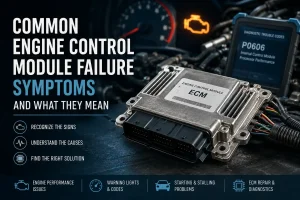
Modern vehicles depend on a complex network of electronic systems that work together to deliver performance, fuel efficiency, emissions compliance, and reliability. At the center of engine management is the Engine Control Module (ECM), a specialized computer responsible for monitoring operating conditions and making continuous adjustments to keep the engine running properly.
The ECM receives information from dozens of sensors throughout the vehicle and uses that data to control critical functions such as fuel injection, ignition timing, idle speed, air-fuel mixture, emissions systems, and overall engine performance. Every time you start your vehicle, accelerate, brake, or drive under changing conditions, the ECM is processing information and making decisions in real time.
As vehicles become increasingly dependent on software and electronic communication systems, understanding the warning signs of ECM failure has become more important than ever. Many symptoms that drivers experience daily can be directly or indirectly linked to problems within the engine management system.
Why ECM Problems Are Frequently Misdiagnosed
One of the most challenging aspects of diagnosing ECM problems is that the symptoms often mimic failures in completely different systems. A faulty sensor, damaged wiring harness, weak battery, failing alternator, poor ground connection, or communication network issue can create symptoms that look remarkably similar to a failing Engine Control Module.
This is why replacing parts based solely on symptoms often leads to unnecessary repairs and continued frustration. Modern vehicles are highly interconnected, meaning one problem can create symptoms across multiple systems simultaneously.
Professional diagnostics focus on identifying the root cause rather than simply reacting to warning lights or performance issues. Understanding common ECM symptoms helps vehicle owners recognize potential problems, but accurate testing remains essential before any repair decisions are made.
What Does the Engine Control Module Actually Control?
The ECM serves as the brain of the engine management system. It constantly evaluates sensor inputs and adjusts engine operation based on current driving conditions.
The module influences numerous vehicle functions, including:
- Fuel injector operation
- Ignition timing adjustments
- Air-fuel ratio management
- Emissions system control
- Engine idle stability
- Performance optimization
- Diagnostic monitoring
Because the ECM affects so many areas of vehicle operation, even a relatively small problem can create noticeable changes in drivability, efficiency, and reliability.
Core ECM Functions
| ECM Function | Purpose |
|---|---|
| Fuel Injection Control | Regulates fuel delivery |
| Ignition Timing | Controls combustion timing |
| Air-Fuel Ratio Management | Optimizes engine efficiency |
| Idle Speed Control | Maintains stable engine operation |
| Emissions Monitoring | Supports environmental compliance |
| Diagnostic Functions | Detects and stores fault codes |
| Sensor Processing | Interprets operating conditions |
A problem affecting any of these functions may produce symptoms that drivers experience on a daily basis.
Common Engine Control Module Failure Symptoms
When an ECM begins to fail, symptoms often develop gradually rather than appearing all at once. Some drivers notice minor performance issues first, while others encounter warning lights or communication faults before drivability concerns become obvious.
The exact symptoms vary depending on the vehicle, manufacturer, software architecture, and nature of the failure. However, certain warning signs appear consistently across many platforms.
Persistent Check Engine Light
One of the most common indicators of ECM-related issues is an illuminated check engine light that repeatedly returns even after other repairs have been performed. While many different vehicle problems can trigger this warning, the ECM is responsible for monitoring engine operation and storing diagnostic information whenever abnormalities are detected.
A persistent warning light does not automatically mean the ECM has failed. However, recurring communication codes, internal control module codes, or unexplained system faults often justify a deeper investigation into the engine management system.
Many ECM-related issues first become noticeable through diagnostic trouble codes before major drivability symptoms appear.
Engine Stalling During Operation
Unexpected stalling is another symptom frequently associated with ECM problems. Because the module controls fuel delivery and ignition strategies, interruptions in communication or processing can affect engine operation significantly.
Some vehicles stall only occasionally at first. Others develop increasingly frequent shutdowns that eventually make the vehicle unreliable. In many situations, the problem appears intermittent, which makes diagnosis more challenging.
When stalling occurs alongside communication faults, warning lights, or inconsistent performance, ECM involvement becomes more likely.
Hard Starting and No-Start Conditions
The starting process depends heavily on proper communication between multiple vehicle systems. The ECM must receive sensor information, authorize fuel delivery, coordinate ignition timing, and interact with other control modules before the engine can start successfully.
When an Engine Control Module develops faults, these processes may become disrupted. Drivers often report extended cranking times, intermittent starting issues, or complete no-start conditions.
One important thing to remember is that many no-start situations have causes unrelated to the ECM. Batteries, starters, fuel systems, immobilizers, and wiring faults can create similar symptoms. This is why comprehensive testing is necessary before concluding that the module itself has failed.
Performance Problems Often Linked to ECM Failure
Not every ECM issue results in a warning light or a vehicle that refuses to start. In many cases, performance declines gradually as the module struggles to process information accurately.
Drivers may initially notice that the vehicle simply feels different. Acceleration becomes less responsive, engine operation feels inconsistent, and overall drivability begins to deteriorate.
Reduced Engine Power
A failing ECM may cause reduced power output by delivering inaccurate commands to engine systems. Because fuel delivery, ignition timing, and airflow calculations depend on ECM decisions, incorrect calculations can significantly affect performance.
In some situations, the module intentionally limits performance to protect the engine. This protective strategy is commonly referred to as limp mode and is designed to reduce the risk of further damage.
Hesitation During Acceleration
Acceleration hesitation often occurs when the ECM struggles to process sensor information correctly. Delayed throttle response, inconsistent power delivery, or noticeable lag during acceleration may indicate problems affecting the engine management system.
Although sensor failures frequently contribute to hesitation issues, ECM-related problems should not be overlooked when multiple symptoms appear together.
Rough Idle Conditions
Maintaining a smooth idle requires constant adjustments by the Engine Control Module. Small changes in airflow, engine load, and operating conditions require immediate corrections to keep the engine running consistently.
When communication errors or processing issues occur, the ECM may no longer make accurate adjustments. The result can be rough idle conditions, fluctuating RPM levels, or unstable engine operation while the vehicle is stationary.
Can a Bad ECM Cause Misfires?
Engine misfires are commonly associated with spark plugs, ignition coils, fuel injectors, and mechanical engine issues. However, the ECM also plays a major role in combustion management.
Because the module determines when fuel is delivered and when ignition events occur, incorrect calculations can directly affect combustion efficiency. This may create misfires, hesitation, rough operation, and reduced performance.
One characteristic of ECM-related misfires is inconsistency. Rather than affecting a single cylinder continuously, symptoms may appear across different cylinders at different times depending on operating conditions and communication issues.
Common Symptoms That May Accompany ECM-Related Misfires
When misfires originate from engine management issues, drivers often notice additional symptoms such as:
- Rough idle conditions
- Poor throttle response
- Reduced fuel economy
- Check engine lights
- Communication-related fault codes
The presence of multiple symptoms frequently provides stronger diagnostic clues than a misfire alone.
Can ECM Problems Affect Fuel Economy?
Fuel economy often suffers when engine management calculations become inaccurate. The ECM continuously evaluates information from multiple sensors before determining how much fuel should be delivered under current conditions.
When those calculations become unreliable, the vehicle may consume more fuel than necessary. Drivers sometimes notice declining fuel economy long before more obvious symptoms develop.
Because fuel consumption can be influenced by numerous factors, technicians typically evaluate overall vehicle performance rather than relying on fuel economy alone as a diagnostic indicator.
Why Fuel Management Depends on Accurate Data
Modern fuel management systems rely on constant communication between sensors and control modules. Airflow measurements, throttle position, oxygen sensor feedback, temperature readings, and load calculations all influence fuel delivery decisions.
If the ECM receives inaccurate information or processes correct information incorrectly, fuel delivery strategies may become inefficient. This not only affects fuel economy but may also contribute to emissions concerns and drivability issues.
Communication Problems and Network Faults
One of the most overlooked aspects of ECM diagnostics involves vehicle communication networks. Modern vehicles rely heavily on systems such as the CAN Bus network to exchange information between modules.
The ECM functions as one of the most important participants in this network. When communication problems develop, the effects can extend beyond engine performance and affect multiple vehicle systems simultaneously.
Communication-related issues may produce:
- U-codes
- Lost communication codes
- Multiple warning lights
- Intermittent system failures
- Limp mode activation
Because network communication affects numerous modules, these symptoms often appear more complicated than traditional mechanical failures.
Symptoms That Frequently Appear Together
ECM failures rarely create a single isolated symptom. More commonly, multiple warning signs develop simultaneously because the module influences numerous vehicle functions.
| Symptom Combination | Potential ECM Involvement |
| Check Engine Light + Communication Codes | Very High |
| Stalling + No-Start Condition | High |
| Reduced Power + Limp Mode | High |
| Rough Idle + Poor Fuel Economy | Medium to High |
| Multiple Warning Lights + Network Errors | Very High |
Recognizing these symptom patterns often helps technicians prioritize their diagnostic approach and identify potential engine management concerns more efficiently.
Why Early Diagnosis Makes a Difference
Electronic problems rarely resolve themselves. In many cases, small communication faults, voltage irregularities, software corruption, or component degradation gradually become more severe over time.
Early diagnosis helps prevent unnecessary parts replacement and reduces the likelihood of secondary issues affecting other systems. Since modern vehicles depend heavily on communication between modules, even seemingly minor electronic faults can eventually impact overall reliability.
Understanding common Engine Control Module failure symptoms gives vehicle owners a valuable foundation for recognizing potential problems and seeking professional diagnostics before drivability concerns become more serious.
In the next section, we’ll explore the most common causes of ECM failure, how professional diagnostics identify module-related problems, how communication testing works, and the differences between ECM repair, ECM programming, ECM reprogramming, and module replacement.
What Causes an Engine Control Module to Fail?
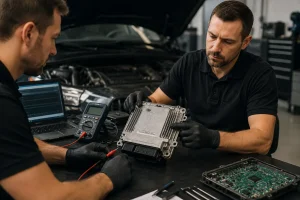
Although Engine Control Modules are designed to operate for many years, they are constantly exposed to conditions that can affect electronic reliability. Heat, vibration, moisture, voltage fluctuations, and aging components all contribute to wear over time.
Unlike mechanical components that typically show obvious signs of deterioration, ECM failures often develop gradually. Small communication issues, intermittent faults, or occasional warning lights may appear long before complete module failure occurs.
Understanding the most common causes of ECM failure helps vehicle owners recognize why accurate diagnostics are so important.
Environmental Factors That Affect ECM Reliability
The engine compartment is one of the harshest environments in any vehicle. Electronic modules must operate while exposed to significant temperature changes, vibration, humidity, and contaminants.
Over time, these conditions can affect internal circuitry, solder joints, and electrical connections. Moisture intrusion is particularly damaging because corrosion may continue spreading long after the initial exposure occurred.
Even vehicles that appear to be operating normally can develop hidden electronic damage that gradually affects module performance.
Electrical Problems That Damage ECMs
Modern control modules depend on stable voltage levels. When electrical irregularities occur, sensitive electronic components can become damaged or begin operating unpredictably.
Common electrical causes of ECM failure include:
Charging system malfunctions
Faulty alternators
Battery failures
Voltage spikes
Improper jump-start procedures
Damaged ground connections
Because electrical problems can affect multiple modules simultaneously, technicians often evaluate the entire electrical system during diagnostics rather than focusing solely on the ECM.
Most Common ECM Failure Causes
| Cause | Potential Impact |
|---|---|
| Water Intrusion | Corrosion and circuit damage |
| Excessive Heat | Component degradation |
| Voltage Spikes | Internal electronic failure |
| Poor Grounds | Communication interruptions |
| Connector Corrosion | Signal loss |
| Aging Electronics | Reduced reliability |
| Wiring Damage | Communication faults |
| Charging System Issues | Unstable module operation |
Many ECM failures result from a combination of factors rather than a single isolated event.
How Professional Technicians Diagnose ECM Problems
One of the biggest mistakes vehicle owners make is assuming that a fault code automatically identifies the failed component. Modern diagnostics involve far more than connecting a scan tool and reading stored information.
Professional technicians use a structured process designed to eliminate possibilities and verify evidence before recommending repairs.
This approach is particularly important because ECM symptoms often resemble issues caused by sensors, wiring, communication networks, or power supply problems.
The ECM Diagnostic Process
A proper diagnostic workflow typically follows several stages designed to isolate the source of the problem.
| Diagnostic Stage | Objective |
|---|---|
| Fault Code Analysis | Identify stored trouble codes |
| Visual Inspection | Check connectors and wiring |
| Power and Ground Testing | Verify electrical integrity |
| Communication Testing | Evaluate network functionality |
| Sensor Verification | Confirm input accuracy |
| Bench Testing | Analyze ECM performance |
| Final Validation | Confirm root cause |
By following this process, technicians can distinguish between a failed module and a problem originating elsewhere in the vehicle.
Why Fault Codes Don’t Always Tell the Full Story
Diagnostic Trouble Codes provide valuable information, but they rarely provide complete answers. A communication code, for example, may indicate a failed module, a damaged connector, wiring damage, or a network-related problem.
Similarly, a sensor-related code does not always mean the sensor itself has failed. In some cases, the ECM may be processing information incorrectly, creating symptoms that appear sensor-related even when the sensor is functioning properly.
This is why experienced diagnostic specialists focus on understanding the relationship between fault codes, live data, communication networks, and vehicle behavior.
Understanding ECM Communication and CAN Bus Networks
Modern vehicles operate through communication networks that allow dozens of modules to exchange information continuously. The most common of these systems is the Controller Area Network, commonly known as the CAN Bus.
The ECM serves as one of the primary communication hubs within this network. It receives information from sensors, exchanges data with transmission modules, communicates with body control systems, and coordinates engine-related functions throughout the vehicle.
When communication is disrupted, symptoms may extend far beyond engine performance.
Common Signs of Communication Problems
Communication-related issues often create unusual combinations of symptoms that can confuse both drivers and inexperienced technicians.
Some of the most common indicators include:
Multiple warning lights appearing simultaneously
Intermittent communication fault codes
Loss of communication with certain modules
Limp mode activation
Unexpected system shutdowns
These symptoms frequently indicate the need for advanced network diagnostics rather than simple component replacement.
Why Communication Failures Matter
As vehicles become more electronically integrated, communication reliability becomes increasingly important. A module may be functioning correctly internally while still causing problems because it cannot communicate with the rest of the vehicle.
This distinction is important because repairing communication issues often requires a completely different approach than repairing hardware failures inside the ECM itself.
ECM Repair vs ECM Reprogramming vs ECM Replacement
Once diagnostics confirm ECM involvement, the next step is determining the most appropriate solution. Depending on the nature of the failure, the module may require repair, reprogramming, replacement, or a combination of these services.
Understanding the differences helps vehicle owners better understand the recommendations they receive during diagnostics.
ECM Repair
ECM repair focuses on restoring the original module by correcting hardware-related problems. This may involve repairing damaged circuitry, replacing failed components, correcting communication faults, or addressing internal electronic issues.
Repair allows the original module to remain in service while preserving vehicle-specific information already stored within the unit.
ECM Reprogramming
Reprogramming focuses on software rather than hardware. Some ECM problems originate from corrupted calibration files, outdated software, configuration issues, or programming errors.
In these situations, updating or correcting the software may restore normal operation without extensive hardware repairs.
ECM Replacement
Replacement becomes necessary when the original module cannot be repaired or when internal damage is too extensive to justify restoration.
Replacement modules frequently require additional programming procedures before they can operate correctly within the vehicle.
Comparing ECM Service Options
| Service | Primary Purpose |
|---|---|
| ECM Repair | Restore existing hardware |
| ECM Reprogramming | Correct software issues |
| ECM Programming | Install required software |
| ECM Replacement | Install another module |
| ECM Diagnostics | Identify root cause |
The most appropriate solution depends entirely on the results of professional testing.
Why Bench Testing Plays Such an Important Role
Many ECM failures cannot be fully identified while the module remains installed in the vehicle. Bench testing allows technicians to evaluate module behavior in a controlled environment using specialized equipment.
By simulating vehicle operating conditions, technicians can monitor communication activity, evaluate circuit behavior, verify processing functions, and identify failures that may not appear during normal vehicle operation.
Bench testing has become one of the most valuable tools available in modern automotive electronics diagnostics.
Benefits of ECM Bench Testing
Bench testing provides several advantages:
Confirms module functionality
Identifies intermittent failures
Verifies communication performance
Evaluates internal circuitry
Supports repair validation
Reduces diagnostic uncertainty
For complex electronic issues, bench testing often provides the level of certainty needed before major repair decisions are made.
When Should Drivers Seek Professional ECM Diagnostics?
Many drivers wait until a vehicle becomes difficult to drive before seeking assistance. However, electronic issues are often easier to diagnose and repair when addressed early.
If symptoms continue appearing repeatedly, professional diagnostics should be considered.
Warning signs that deserve attention include:
Recurring check engine lights
Repeated communication fault codes
Intermittent stalling
Reduced engine performance
Hard starting conditions
Limp mode activation
Multiple warning lights appearing together
Addressing these symptoms early often helps prevent additional complications and reduces diagnostic complexity.
Final Thoughts on Engine Control Module Failure Symptoms
The Engine Control Module plays a central role in modern vehicle operation. From fuel delivery and ignition timing to emissions management and communication networks, nearly every aspect of engine performance depends on the ECM functioning correctly.
Because the module interacts with so many systems, its failure can create a wide variety of symptoms that are often mistaken for unrelated problems. Check engine lights, stalling, reduced power, communication faults, misfires, poor fuel economy, and no-start conditions may all indicate issues involving the engine management system.
While recognizing these warning signs is important, professional diagnostics remain the most reliable way to determine whether the ECM is truly responsible. Accurate testing helps distinguish module failures from sensor problems, communication faults, wiring issues, and other conditions that can produce similar symptoms.
Need Professional Engine Control Module Diagnostics or Repair?
If you’re experiencing warning lights, communication errors, starting issues, engine performance concerns, or suspected ECM failures, the team at Module Authority can help identify the source of the problem and recommend the most effective solution.
Call today: (561) 887-4477
Or contact our team directly through our contact page to discuss your vehicle’s symptoms and diagnostic needs.
Find Trusted ECM Repair Services Near You
Engine Control Module problems can affect virtually any modern vehicle, regardless of manufacturer or model. Whether you’re dealing with communication faults, intermittent drivability issues, no-start conditions, or suspected engine computer failures, working with specialists who understand advanced automotive electronics can make the diagnostic process far more effective.
If you’re located in one of the areas below, explore our dedicated ECM repair pages for additional information and local support: