
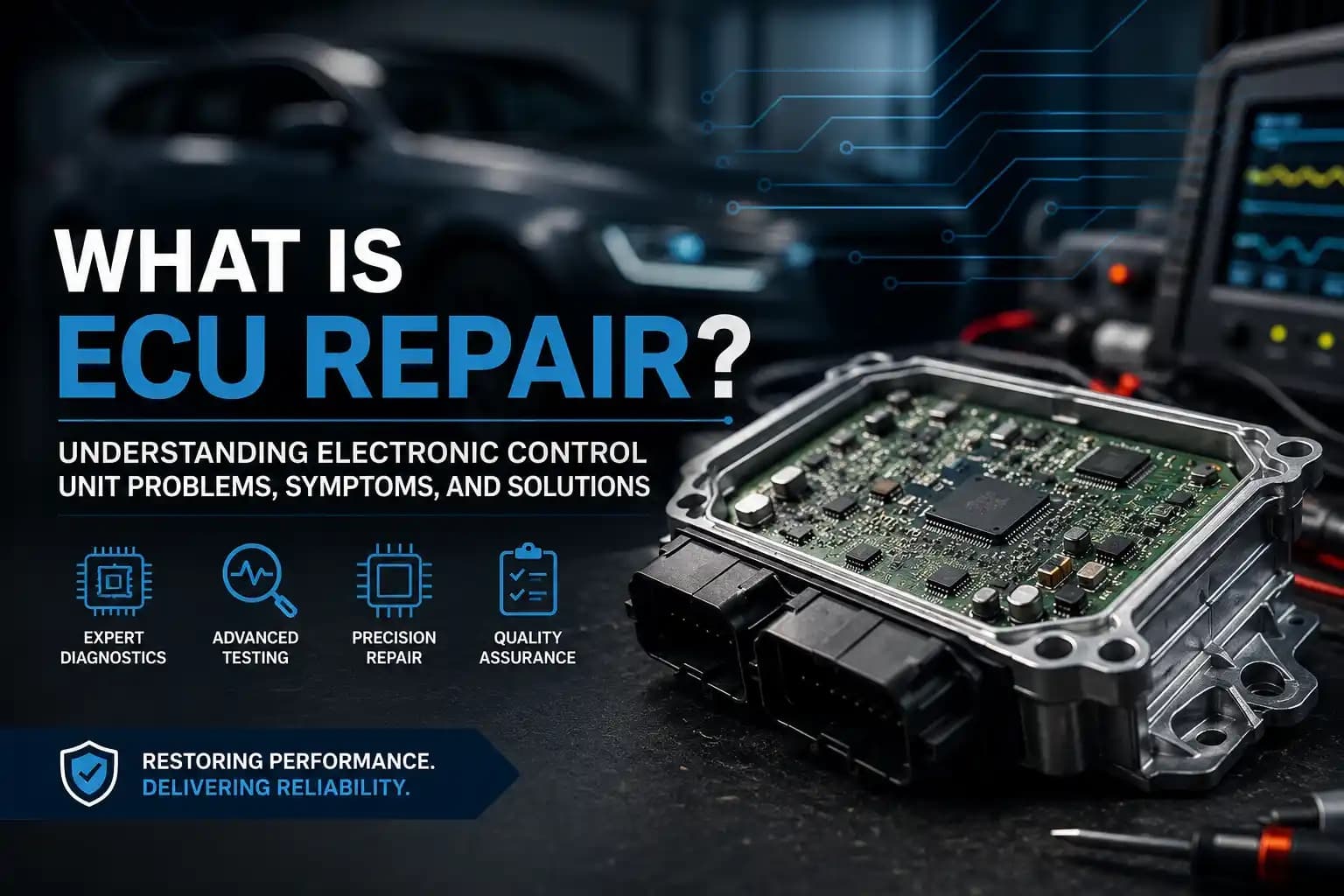
What Is ECU Repair? Understanding Electronic Control Unit Problems, Symptoms, and Solutions
Why ECU Repair Has Become So Important in Modern Vehicles
Understanding the Role of the Electronic Control Unit
The Electronic Control Unit, commonly referred to as the ECU, is essentially a specialized computer designed to manage specific vehicle functions. It constantly receives information from sensors located throughout the vehicle, analyzes that information, and makes decisions based on programmed parameters developed by the manufacturer.
Every time a driver accelerates, brakes, starts the engine, or shifts gears, the ECU is processing data and issuing commands. This process happens continuously and often thousands of times per minute.
Without a properly functioning ECU, many of the systems drivers rely on every day would not be able to operate correctly.
ECU, ECM, PCM, TCM, and BCM Explained
One source of confusion for vehicle owners is the terminology used to describe vehicle computers. While these terms are often used interchangeably, they do not always refer to the same module.
Understanding these distinctions is important because different symptoms can point toward different modules.
For example, transmission shifting concerns may indicate a TCM-related issue, while electrical accessory failures may point toward a BCM problem.
How Vehicle Computers Communicate With Each Other
Modern vehicles do not rely on a single computer. Instead, they operate through a network of interconnected modules that constantly exchange information.
This communication occurs through systems such as the Controller Area Network (CAN Bus). The CAN Bus allows modules to share information efficiently, ensuring that different vehicle systems can work together.
For example, the ECU may need information from wheel speed sensors, transmission modules, throttle position sensors, and safety systems before making decisions regarding engine performance.
If communication is interrupted, even a healthy module may appear faulty because it is no longer receiving the information it needs.
Why Communication Networks Matter
Many drivers assume a warning light automatically means a component has failed. In reality, communication problems are often responsible for symptoms that appear to be module failures.
A communication fault can cause:
- Multiple warning lights
- Loss of module communication
- Intermittent drivability issues
- Network-related diagnostic trouble codes
This is one reason professional diagnostics focus not only on the module itself but also on the communication pathways connecting the vehicle’s electronic systems.
Common Signs of ECU Failure
Because the ECU interacts with numerous vehicle systems, its failure can produce a wide range of symptoms. Some are obvious, while others can easily be mistaken for sensor failures, ignition problems, or fuel system issues.
One of the reasons ECU diagnosis requires experience is that the symptoms often overlap with problems caused by entirely different components.
Most Common ECU Failure Symptoms
These symptoms do not automatically confirm ECU failure, but they often justify further investigation.
Why Does a Failed ECU Trigger So Many Different Problems?
The answer lies in the ECU’s role as a decision-making center. The module processes information from multiple sensors and distributes commands throughout the vehicle. If its calculations become inaccurate or communication is interrupted, the effects can spread across numerous systems simultaneously.
This explains why some vehicles develop combinations of symptoms that initially appear unrelated.
A driver may experience a check engine light, rough idle, and transmission concerns at the same time, even though the root cause originates from a single module.
What Causes an ECU to Fail?
Electronic control units are designed to withstand challenging operating conditions. However, like any electronic component, they are not immune to damage, environmental stress, or aging.
Most ECU failures occur gradually rather than suddenly.
Common Causes of ECU Failure
While every vehicle is different, moisture and voltage-related issues remain among the most frequently diagnosed causes of module failure.
Can Water Damage an ECU?
Water intrusion is one of the most destructive threats to electronic modules. Moisture can damage circuit boards, corrode electrical pathways, and interfere with communication signals. In many cases, water damage begins long before symptoms become obvious.
A vehicle may continue operating normally for months while corrosion slowly develops inside the module or connector.
Can a Weak Battery Affect ECU Performance?
Many vehicle owners are surprised to learn that battery health can influence module behavior. Modern control modules rely on stable voltage levels. When voltage becomes inconsistent, communication errors, fault codes, and unusual module behavior may occur.
Although a weak battery does not always damage the ECU itself, prolonged voltage instability can contribute to electronic problems throughout the vehicle.
How ECU Problems Are Diagnosed
One of the biggest misconceptions in automotive repair is the belief that reading fault codes automatically identifies the failed component.
Professional diagnostics involve a much more comprehensive process.
Technicians evaluate the entire electronic environment surrounding the module before determining whether repair, reprogramming, or replacement is necessary.
The ECU Diagnostic Process
This systematic approach reduces unnecessary part replacements and helps isolate the true source of the problem.
Why Fault Codes Alone Are Not Enough
Diagnostic Trouble Codes provide valuable clues, but they rarely tell the entire story.
For example, a communication code may indicate:
- A failed module
- A damaged connector
- Wiring issues
- Network communication failures
- Voltage irregularities
Without additional testing, replacing a module based solely on fault codes can result in misdiagnosis.
The Difference Between ECU Repair and ECU Replacement
When a module-related problem is confirmed, vehicle owners often assume replacement is the only solution. In reality, many electronic control units can be repaired depending on the type and severity of the failure.
Repair focuses on restoring the existing module, while replacement involves installing another unit and often performing additional programming procedures.
ECU Repair vs ECU Replacement
The appropriate solution depends on the condition of the module, diagnostic findings, and vehicle requirements.
Why Modern ECU Repairs Often Involve Software
Vehicle electronics are no longer purely hardware-driven. Many control modules rely on sophisticated software, firmware, and calibration files to function correctly.
As a result, some ECU problems originate from software-related issues rather than physical damage.
A module may require software correction, reprogramming, firmware updates, or communication restoration even when no obvious hardware failure exists.
This evolution has transformed automotive diagnostics into a combination of electronics, software engineering, and vehicle systems expertise.
Hardware Failures vs Software Failures
Understanding this distinction is increasingly important as vehicle technology becomes more advanced.
Why Accurate Diagnosis Matters Before Any Repair Decision
Many ECU-related symptoms resemble problems caused by completely different components. Sensors, wiring, batteries, alternators, relays, and communication networks can all produce symptoms that appear identical to module failure.
This is why experienced technicians prioritize diagnosis before recommending repairs.
Replacing components without understanding the underlying cause often leads to unnecessary expenses, continued drivability issues, and frustration for vehicle owners.
A structured diagnostic process ensures that repair decisions are based on evidence rather than assumptions.
The Growing Importance of ECU Repair in 2026
As vehicle technology continues to advance, electronic control units are becoming even more integrated into daily vehicle operation. Features that once relied on mechanical systems now depend heavily on software-driven control modules and communication networks.
From engine management and emissions control to advanced diagnostics and performance optimization, the ECU remains one of the most important components in any modern vehicle.
Understanding how these modules function, what causes them to fail, and how professional diagnostics identify problems provides a strong foundation for making informed repair decisions.
In the next section, we’ll explore how ECU repair actually works, including bench testing, component-level diagnostics, ECU programming, module cloning, software flashing, and the processes used to restore modern vehicle computers to proper operation.
How ECU Repair Actually Works
Once diagnostics confirm that the Electronic Control Unit is contributing to a vehicle problem, the next step is determining the most appropriate solution. Contrary to what many vehicle owners believe, ECU repair is not simply a matter of replacing a computer and hoping the issue disappears. Modern module repair involves diagnostics, electronics testing, software analysis, communication verification, and quality control procedures designed to identify the root cause of the failure.
Because every module failure is different, the repair process typically begins with a detailed evaluation of both the hardware and software components inside the ECU.
The Typical ECU Repair Workflow
The repair process usually follows a structured sequence designed to eliminate guesswork and ensure reliability.
This process allows technicians to determine whether the module requires repair, reprogramming, cloning, replacement, or a combination of these procedures.
Why Bench Testing Is So Important
Many ECU failures cannot be fully identified while the module remains installed in the vehicle.
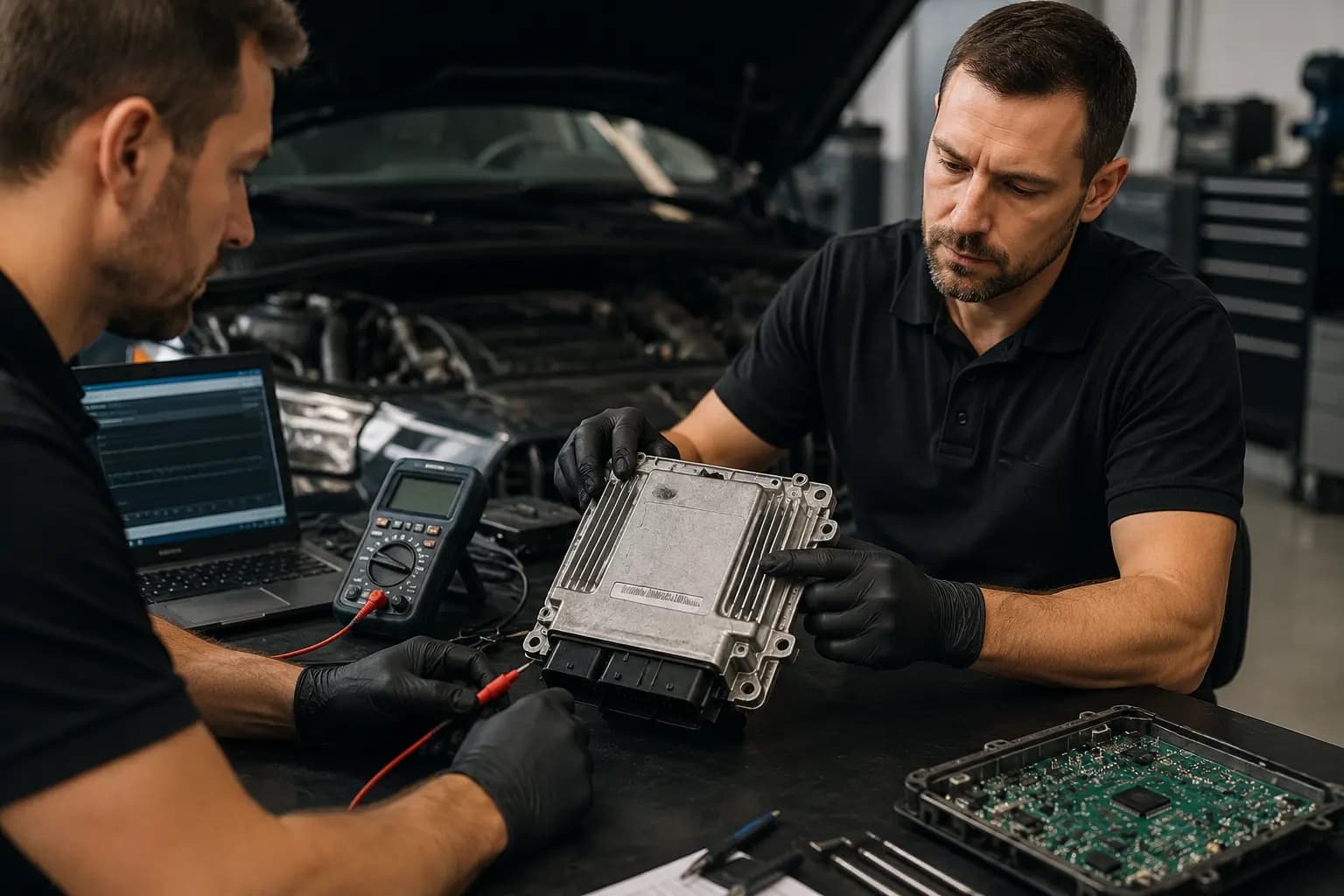
Bench testing allows technicians to simulate operating conditions while monitoring internal module behavior. This controlled environment often reveals communication faults, voltage irregularities, corrupted memory data, or component failures that would otherwise remain hidden.
For modern vehicle electronics, bench testing has become one of the most valuable tools available for accurate diagnostics.
Common Internal ECU Failures
Not all ECU problems originate from software. In many cases, the issue involves physical damage to the electronic components inside the module.
Some of the most common failures include:
These failures often develop gradually, creating intermittent symptoms before complete module failure occurs.
Understanding ECU Programming and Reprogramming
Modern control modules depend on software just as much as hardware. Even when a module is physically healthy, programming issues can cause significant drivability problems.
What Is ECU Programming?
ECU programming refers to the process of installing or configuring software within a control module. Manufacturers use programming to ensure the module contains the correct operating parameters for a specific vehicle.
Programming is commonly required when:
- Installing a replacement ECU
- Updating vehicle software
- Configuring a new module
- Restoring factory settings
What Is ECU Reprogramming?
Reprogramming involves modifying or updating existing software already stored inside the module.
In some situations, software corruption can create symptoms that resemble hardware failure. Reprogramming may restore normal operation without requiring extensive repairs.
Examples include:
- Corrupted calibration files
- Software communication issues
- Firmware inconsistencies
- Manufacturer software updates
ECU Repair vs ECU Reprogramming
These services are related but not identical.
Understanding this distinction helps vehicle owners better understand the solutions being recommended during diagnostics.
What Is ECU Cloning?
One of the most misunderstood topics in automotive electronics is ECU cloning.
Cloning involves transferring critical data from one module to another. Rather than manually recreating configuration information, technicians copy the relevant data from the original module and transfer it into a compatible replacement unit.
This process allows the replacement module to function as though it were the original.
Why ECU Cloning Is Used
Cloning is often used when a module is damaged beyond practical repair but still contains recoverable data.
Important information may include:
- VIN information
- Security data
- Immobilizer information
- Vehicle configuration files
- Calibration settings
Without this information, a replacement module may not communicate properly with the vehicle.
ECU Cloning vs ECU Programming
Although these processes are different, they are frequently performed together during complex module repairs.
Understanding EEPROM and Vehicle Data Storage
Modern ECUs contain memory chips that store critical information required for vehicle operation.
One of the most important forms of memory is EEPROM, which stands for Electrically Erasable Programmable Read-Only Memory.
EEPROM stores information that remains available even when the vehicle is turned off.
This data may include:
- Vehicle identification information
- Immobilizer data
- Security configurations
- Calibration settings
- Operating parameters
When technicians perform ECU cloning, EEPROM data is often one of the most important elements being transferred.
What Is Immobilizer Matching?
Vehicle security systems have become increasingly sophisticated. Most modern vehicles use an immobilizer system designed to prevent unauthorized starting.
The ECU often communicates directly with:
- Security modules
- Key transponders
- Immobilizer systems
When a replacement module is installed, these systems may no longer recognize each other.
Immobilizer matching ensures that the various security components can communicate correctly and authorize vehicle operation.
Without proper matching, a vehicle may crank but fail to start.
Can a Bad ECU Cause Real-World Driving Problems?
One of the reasons ECU repair generates so much interest is that module failures can create symptoms affecting daily vehicle operation.
No Start Conditions
A failed ECU may prevent proper fuel delivery, ignition operation, or communication with security systems. In these situations, the vehicle may crank normally but refuse to start.
Engine Stalling
When module communication becomes unstable, engine operation can become unpredictable. Some vehicles stall intermittently before developing more severe symptoms.
Misfires and Rough Running
Because the ECU controls fuel and ignition strategies, incorrect calculations can lead to rough idle conditions, hesitation, or misfires.
Limp Mode Activation
Many vehicles enter a protective operating mode when critical faults are detected. This condition, commonly called limp mode, limits vehicle performance to prevent additional damage.
Communication Fault Codes
Modern modules rely heavily on communication networks. A failing ECU may generate communication-related diagnostic trouble codes that affect multiple vehicle systems.
Common Symptoms and ECU Involvement
Why Mail-In ECU Repair Has Become So Popular
Many vehicle owners assume ECU repair requires visiting a local repair facility. However, specialized module repair companies frequently perform repairs through mail-in services.
This approach allows vehicle owners, repair shops, and dealerships to access advanced electronic repair capabilities regardless of location.
How Mail-In ECU Repair Works
The process is relatively straightforward.
The module is removed from the vehicle and shipped to a specialized repair facility. Technicians perform diagnostics, repairs, programming, cloning, or testing as required before returning the module.
This process is particularly useful for modules that require specialized equipment not commonly available at general repair shops.
Benefits of Mail-In ECU Repair
Mail-in services provide access to:
- Advanced bench testing
- Specialized module diagnostics
- Component-level repairs
- Programming services
- Cloning services
- Quality control verification
As vehicle electronics become more sophisticated, mail-in repair solutions continue to play an increasingly important role in the automotive repair industry.
Choosing the Right ECU Repair Solution
Every ECU failure is different. Some modules require hardware repair, while others benefit from software correction, cloning procedures, or replacement strategies.
The most important factor is accurate diagnosis.
Modern vehicle electronics are highly interconnected, and symptoms that appear to indicate module failure may sometimes originate from wiring problems, network communication faults, power supply issues, or sensor-related concerns.
A professional diagnostic process helps ensure that repair decisions are based on evidence rather than assumptions.
Final Thoughts on ECU Repair
Electronic Control Units have become one of the most important components in modern vehicles. They manage critical systems, communicate with other modules, process sensor data, and help ensure efficient vehicle operation.
When problems develop, understanding the difference between ECU repair, programming, reprogramming, cloning, and replacement can help vehicle owners make informed decisions and better understand the diagnostic process.
As automotive technology continues to advance throughout 2026 and beyond, professional ECU diagnostics and repair services will remain essential for maintaining reliability, performance, and communication across increasingly complex vehicle electronic systems.
Need Professional ECU Repair Assistance?
If you’re experiencing communication faults, check engine lights, starting issues, module failures, or other electronic control unit concerns, the team at Module Authority Contact Page can help identify the source of the problem and determine the most effective repair strategy.
Call today: (561) 887-4477
Find ECU Repair Services Throughout South Florida
Electronic control module issues can affect virtually any modern vehicle, regardless of make or model. Whether you’re dealing with communication errors, drivability concerns, software-related faults, or a complete module failure, working with a specialized ECU repair provider can help ensure accurate diagnostics and reliable solutions.
If you’re located in one of the areas below, explore our dedicated local ECU repair pages to learn more about available services in your area:
- ECU Repair in Oakland Park, FL
- ECU Repair in Deerfield Beach, FL
- ECU Repair in Coral Springs, FL
- ECU Repair in Hollywood, FL
- ECU Repair in Dania Beach, FL
- ECU Repair in Fort Lauderdale, FL
- ECU Repair in Plantation, FL
- ECU Repair in Pompano Beach, FL
- ECU Repair in Coconut Creek, FL
- ECU Repair in Margate, FL
- ECU Repair in Boca Raton, FL
- ECU Repair in Delray Beach, FL

Ready to fix your vehicle's electronics?
Mail-in repair with fast turnaround, certified technicians, and warranty-backed results.